
Reston Resident Lookup Evidence
A useful Reston resident lookup does not begin with a claim that one database names every person in town. Reston is a Fairfax County census-designated place, so the evidence is held by Fairfax County and Virginia custodians rather than a municipal resident roll. Start with the fact you need to test. A parcel card can establish that a Reston address and map number exist. A court index can place a name in a case. A historic directory can put a name and address in a past publication. Each result needs a date and a role before it can support a conclusion about a Reston resident.
| Record | What It Can Confirm | Reston Source | Access |
|---|---|---|---|
| Parcel card | Situs, map number, and public owner or mailing display | Fairfax iCare | Free online |
| Parcel map | Address point, parcel geometry, roads, and surrounding context | County map service | Free online |
| Circuit court index | Party name, case number, filing date, status, and activity | eCaseSearch | Free index |
| General District Court index | Party, case, hearing, charge, or code-section fields when public | Virginia court index | Free index |
| Voter record | Authorized status information or limited public-list fields | Virginia Elections | Restricted route |
| Vital record | Family or event facts when public or when the requester qualifies | Virginia Vital Records | Age and eligibility rules |
For a current Reston question, compare the public parcel information with an independent dated record. For a historical question, use Fairfax local-history collections, the Reston Regional Library, or a directory collection alongside a deed, notice, or map. A license, association contact, or business filing may help identify a role, but it should not be relabeled as proof that someone lives at a Reston address.
Build a Reston Lookup Key
Before running a Reston resident lookup, make a small identity key. Keep the full name as known, middle initial or other printed name form, likely age range, address, unit if known, cluster or subdivision, and a date window. The place needs the same care. In Fairfax iCare, check the street spelling, number, suffix, unit, map number, and situs, which means the property location. Fairfax GIS can then show whether the Reston address is a parcel, a condominium or cluster, a road segment, or a nonresidential site.
That preparation prevents a common Reston error: silently joining records for people who share a name. An owner may be a trust, estate, or organization. A mailing address can be somewhere else. A directory listing may be old by the time it is printed. Record each match as a role, such as owner, mailing addressee, party, voter, licensee, historical listing, or occupant when an independent record actually says so. The distinction makes a Reston lookup clearer and safer.
Note: Preserve the spelling, date, and source wording for each Reston match so a later reviewer can test the same record.
Check Reston Court Lookup Results
The free Fairfax Circuit Court eCaseSearch index offers civil or criminal case type and a name or case-number route. A name search requires at least two characters in the last-name or company field, while the first name is optional. Many cases are available from October 18, 2004 forward, and the public search returns the first 100 results. Narrow a broad Reston name with the case type, a more complete name, or a known number. The public index does not provide documents, and confidential cases are not shown.
The official Virginia General District Court search is a separate index. Choose the relevant locality and division, then search by plaintiff or defendant name, case number, or hearing date. Fairfax, Herndon, and Vienna are the Fairfax divisions named in the state interface. A Circuit hit does not promise a GDC hit. A court address may be a service, business, counsel, or historic address, so it is not a Reston residence finding by itself.
See the Virginia GDC search form for its locality selector and party, case, and hearing-date choices.
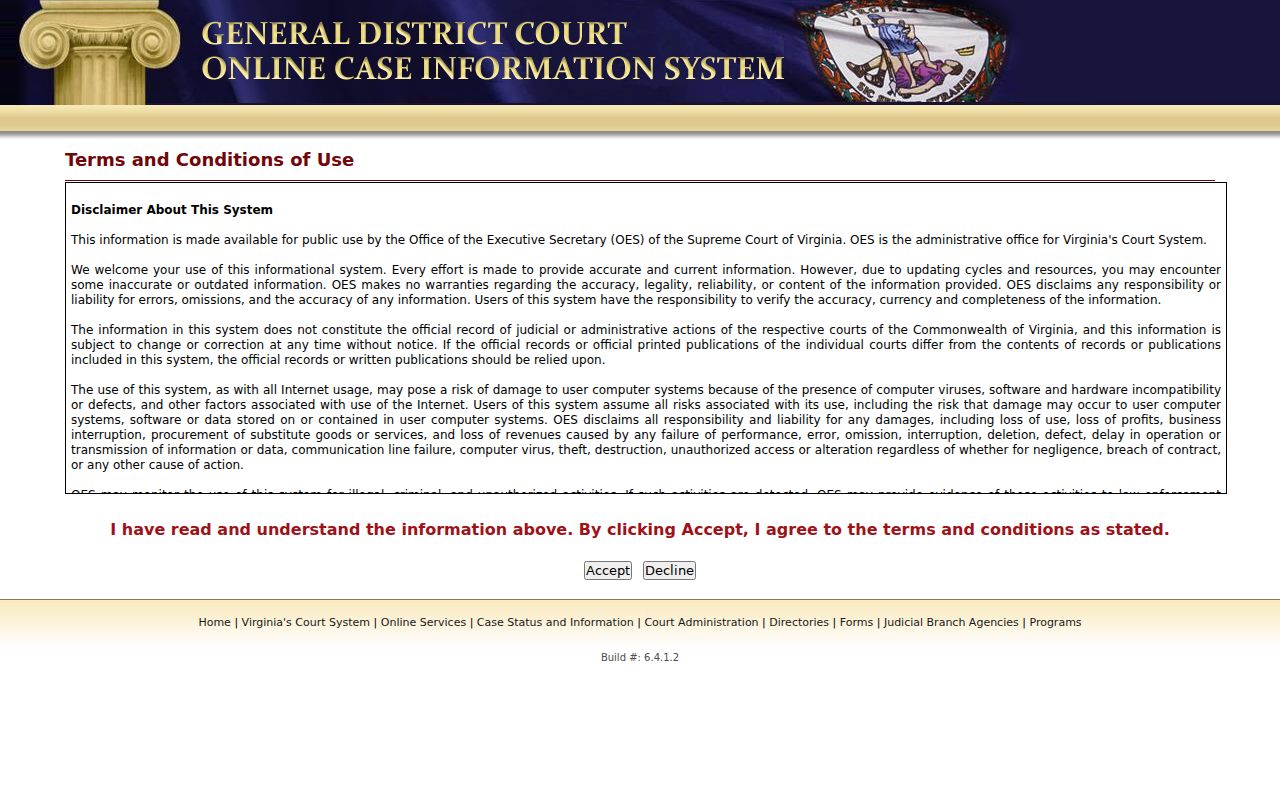
Use the selected Fairfax division and search mode in the research notes, then compare any result with a separately dated Reston address source.
A court index result can contain case number, filed date, status, parties, subtype, attorneys, and recent or register-of-actions information. General District Court results may also show an offense date, hearing date, charge, and code section. Those fields describe the case record, not the person’s present location or conduct beyond the record’s stated status.
| Result field | What to record |
|---|---|
| Case number and court | The unique index reference and the selected Fairfax division |
| Case type and filing date | The case category and the date attached to the court event |
| Party and role | Whether the name appears as plaintiff, defendant, or another stated party |
| Status and activity | The displayed status plus any listed register-of-actions or hearing detail |
| Search mode | Name, case number, or hearing-date route used for the Reston query |
Separate Reston Resident Roles
Fairfax iCare is strong evidence for a Reston parcel, its situs, map number, legal description, sales, assessment context, and the owner or mailing display when public. It is not an occupancy list. The same card can show an owner who lives elsewhere, a mailing addressee, or an online field marked “Name withheld by request.” The withholding is a real privacy state. The Fairfax Department of Tax Administration says a withheld name is still available through office access, but the online display should be left as withheld.
PLUS, court, license, and entity records need the same restraint. A PLUS record can tie a project to an address GIS ID, subdivision, parcel, status, contractor, or account field. DPOR can show a license record address. Virginia SCC filings can show an organization’s office or registered-agent information. These are useful pieces of a Reston identity timeline, yet they do not establish a natural person’s current residence. When the goal shifts from one person to an address-based chain, use the Reston street directory for that separate method.
Verify a Reston Resident
Independent confirmation means comparing records that were made for different purposes and carry matching name, place, and date details. Two sources are better than repeated versions of one source. A public iCare parcel card plus a recorded deed can support ownership. An old address directory entry plus a contemporaneous newspaper item can support a historical listing. Even then, report what each source says rather than turning a likely match into an unqualified claim about a Reston resident.
- Normalize the Reston name and address. Check the postal form, unit, street suffix, map number, and situs before searching a name.
- Open the iCare parcel card and capture the map number, legal description, visible owner or mailing field, and inspection date. Mark a withheld online name exactly as displayed.
- Run the appropriate eCaseSearch and GDC party searches with the correct Fairfax division. Record the case role, date, and number, not a conclusion about residence.
- Test the date window with a library directory, Reston Times index, permit record, or other independent official or archival source. Keep conflicting dates rather than forcing them to agree.
- State the narrow result: owner, party, historical address listing, or another documented role. Flag a non-match after trying reasonable spelling, initial, cluster, ZIP, and old-address variants.
- Docket
- A court’s running record of events in a case, such as filings, hearings, and status entries.
- Index and image
- An index lists identifying fields so a record can be found; an image is the underlying document or scan, which may have different access rules.
- Certified copy
- A copy issued and authenticated by the record custodian for a purpose that requires the office’s certification.
Reston Voter Lookup Authorization
The Virginia Citizen Portal is not a public bulk Reston resident lookup. Its form requests first name, last name, date of birth, last four digits of the Social Security number, locality, and a certification that the user is the voter or is authorized to access the record. The certification warns that unauthorized access may be computer fraud. Do not automate repeated searches, copy sensitive fields, or use a portal result as an open directory of Reston neighbors.
Virginia law provides a different route for public precinct-list inspection through the registrar. The list has limited fields and excludes protected residence addresses and sensitive identity data. More complete voter-file products require a qualifying client type, an active confirmed organization email, defined filters, and authorized use through the Virginia Elections request process. A status match can help test a lawful address hypothesis, but a failed result may reflect a move, spelling difference, inactive status, or protected record.
Note: A voter record has its own access rules and should never be treated as a complete Reston household list.
Reston Vital Record Limits
Virginia Department of Health records can answer an event or family-history question, not a current-address question. Under Va. Code §32.1-271, birth records become public after 100 years. Death, marriage, divorce, and annulment records become public after 25 years. Before those periods, a requester must fit the eligibility rules and provide identification and supporting material where required. A current certificate is not a shortcut for naming a present Reston resident.
Use the Virginia Vital Records route or a Fairfax County local issuing office when eligible. Online ordering, mail, phone, and in-person channels have different timing and document needs. For family history outside the restricted period, VDH directs researchers toward genealogy indexes and historical repositories. Fairfax land and probate records, newspapers, cemetery and church sources, and library archives may be better for a Reston research question when a certificate is unavailable.
Reston License Lookup Limits
The Virginia DPOR License Lookup accepts a name, license number, address, or license type and can show public license status, description, rank, address, and dates. Use it to test whether a named person or organization has the stated Virginia credential. Label any address as a license record address, preserve the displayed update date, and do not convert it into a Reston residency claim.
The Virginia SCC Clerk’s Information System searches entity name or entity ID and can display organization information, formation and status dates, registered-agent or office addresses, and filing context. It may identify the organization behind a Reston project, association, or recorded name. It does not prove where an individual lives. For a record that is not available online, Fairfax County’s Virginia FOIA request form provides an agency-routing route, subject to exemptions and any applicable fees.
Protect Reston Resident Lookup Gaps
A missing Reston result may be a deliberate limit, not evidence that no record exists. Court matters can be confidential, sealed, juvenile, or otherwise excluded. iCare can display an owner name as withheld. Current vital records have age and relationship restrictions. Protected voters have different public-list rules. Virginia’s Address Confidentiality Program, under Va. Code §2.2-515.2, can provide a substitute address and mail-forwarding route for eligible survivors. Do not infer a protected address from nearby data or advise anyone to defeat a protection.
Reston records should be shared narrowly, with the source, date checked, and role attached. Full birth dates, Social Security fragments, protected addresses, victim details, and confidential case information do not belong in a personal research summary. A correction, access, or withholding question belongs with the custodian that keeps the record. That approach respects both the value and the limits of a Reston resident lookup.
Lawful use. Use Reston records for lawful personal research, family history, civic questions, or verifying a record with its custodian. Never use a result to stalk, harass, intimidate, or harm anyone.