
Reston City Directory Holdings
Reston does not have an incorporated-city clerk or a municipal directory series. It is a Fairfax County census-designated place, so its historical directory trail often sits in regional telephone books, Fairfax collections, and Washington-area reference material. Begin with the collection that matches the date, then ask the repository whether it has an alphabetical section, an address-first section, or both. The library pages confirm useful collections, but they do not publish a complete Reston directory run. That limit matters: a missing online title is not proof that a volume never existed.
| Collection route | Verified span | Repository | Practical access |
|---|---|---|---|
| Reston Collection and Reston Times index | Reston history, exact issue years not published | Reston Regional Library | Ask staff for the issue, local file, or directory volume |
| City directories and phone books | Exact Fairfax and Reston runs not published | Virginia Room | Staff can identify a title, year, and possible reverse section |
| Washington Metropolitan Area white pages | 1960/61 sample | Library of Congress digital collection | Regional online context for Fairfax County and Herndon |
| Washington, Maryland, and Virginia criss-cross books | 1968-1996, with listed missing years | Library of Congress reference holdings | Confirm the exact issue onsite before relying on it |
| Fairfax Historical Society records | 1946-2016 | Virginia Room through ARVAS | Collection description online; underlying items are not online |
For a current address, county property systems are more direct. For an earlier household, the value of a dated directory is its date and wording. Record the title, page, locality heading, and publication year before comparing it with a deed, map, or newspaper notice.
Reston’s Regional Directory Trail
Early material may not file a place under “Reston.” The community was planned and developed in Fairfax County during the 1960s, so an older listing can use Fairfax County, Herndon, a route name, a cluster, a subdivision, or a broader Washington metropolitan heading. Search the street, subdivision or cluster, ZIP label, and nearby place names alongside the surname. A one-word place search can miss an otherwise useful record.
The Fairfax Reston historic survey gives the county context for that changing language. It is useful for interpreting place terms, not for turning a development history into a list of residents. When a directory identifies only a regional locality, retain that printed heading rather than silently converting it to a modern Reston address.
Note: A directory heading identifies the publication’s geography, not necessarily the legal boundary used by a later parcel record.
Reston Directory Book Requests
The Virginia Room holds directories, phone books, maps, newspapers, yearbooks, oral histories, photographs, and local-history files. Its holdings can connect an address with the larger Fairfax record trail, but the official collection page does not name a complete Reston publisher list or every year available. Ask for the exact Fairfax or regional volume that matches the target year, and ask whether it has an alphabetical and a criss-cross portion.
A useful request gives staff a surname, initial if known, address spelling, date range, and alternate labels such as Herndon or a cluster name. Ask whether the item is available for reference use, whether a page image or scan can be requested, and whether related maps, newspapers, or yearbooks can fill a gap. The Reston Regional Library also has a special Reston Collection and an indexed Reston Times.
- Reston Regional Library: 11925 Bowman Towne Drive, Reston, VA 20190-3306, 703-689-2700.
- Virginia Room: 10360 North Street, Fairfax, VA 22030, 703-293-6227, option 6.
- Ask for the directory title, year, publisher, page, and locality heading.
- Ask separately whether an address-first volume is held for the same period.
Call before a visit because collection access and branch hours can change. A precise request gives a librarian something verifiable to locate without assuming an unpublished run exists.
Reston Criss-Cross Directory Years
A criss-cross directory is the address-first counterpart to an alphabetical book. The Library of Congress guide records Washington, Maryland, and Virginia suburban holdings from 1968 through 1996. It also identifies missing years: 1975-77, 1981-82, 1984-85, and 1995. Those gaps are part of the evidence, not an invitation to assume a household remained at the same address.
Use the Library of Congress criss-cross directory guide to understand the address-first method, then confirm a particular issue with the library. Search the house number and street, preserving abbreviations exactly as printed. A result can be a family name, business, vacant entry, or cross-reference. It is a lead about an address in one edition, not a complete account of every person connected with the property.
For a house-history question, the criss-cross volume belongs beside a deed date and a property-map year. The separate previous residents record trail uses those sources to follow a parcel backward without treating a directory listing as ownership proof.
Reading Reston City Directory Entries
A city directory entry is a dated publication record. Depending on the volume, it may give a householder, subscriber, business, occupation, telephone number, or street address. It can omit children, recent movers, unlisted numbers, incomplete addresses, and people who declined listing. An alphabetical entry is generally best for moving from a name to an address. An address-first entry is generally best for moving from a house number to a printed name.
| Printed name | Copy initials and spelling exactly. A surname variant may be the key to another volume. |
|---|---|
| Address or street | Capture the number, street form, unit or cluster, locality heading, and any cross-reference. |
| Telephone field | Record it only if printed, along with the directory title and year. |
| Occupation or organization | Keep it as a period detail, not proof of current identity or residence. |
| Page and edition | Preserve the page image, volume, date, and repository so another reader can check it. |
- Criss-cross directory
- An address-first directory arranged by street and house number, often used to locate the printed name attached to an address.
- Householder index
- An alphabetical arrangement that commonly emphasizes the listed household contact rather than every person at an address.
- Abbreviation key
- The volume’s own explanation of shorthand. Photograph or note it before interpreting shortened labels.
Note: A phone subscriber or householder listing is not proof that every person associated with the address lived there on the publication date.
Reston White-Pages Context
The digitized 1960/61 Washington Metropolitan Area white pages include Fairfax County and Herndon in the index. This can help with regional names and address wording from the period before most Reston homes were occupied. It should not be presented as a complete Reston directory. The publication is regional, and its date predates the community’s main residential development.
When a listing appears, capture the printed name, telephone number if present, street or address if present, place heading, directory year, and page image. Then compare it with development chronology, a deed or map, and later directory material. A blank search can reflect a regional heading, an unlisted line, irregular publication, or an address that did not yet exist in its present form.
Reston Times and Archive Leads
The Reston Regional Library identifies an indexed Reston Times and a special Reston Collection. Those resources can surface organization names, obituaries, development notices, local events, and neighborhood terms that directory books may not capture. Ask staff for exact issue coverage and search terms. The official branch page does not promise a complete directory inventory or an exhaustive obituary index.
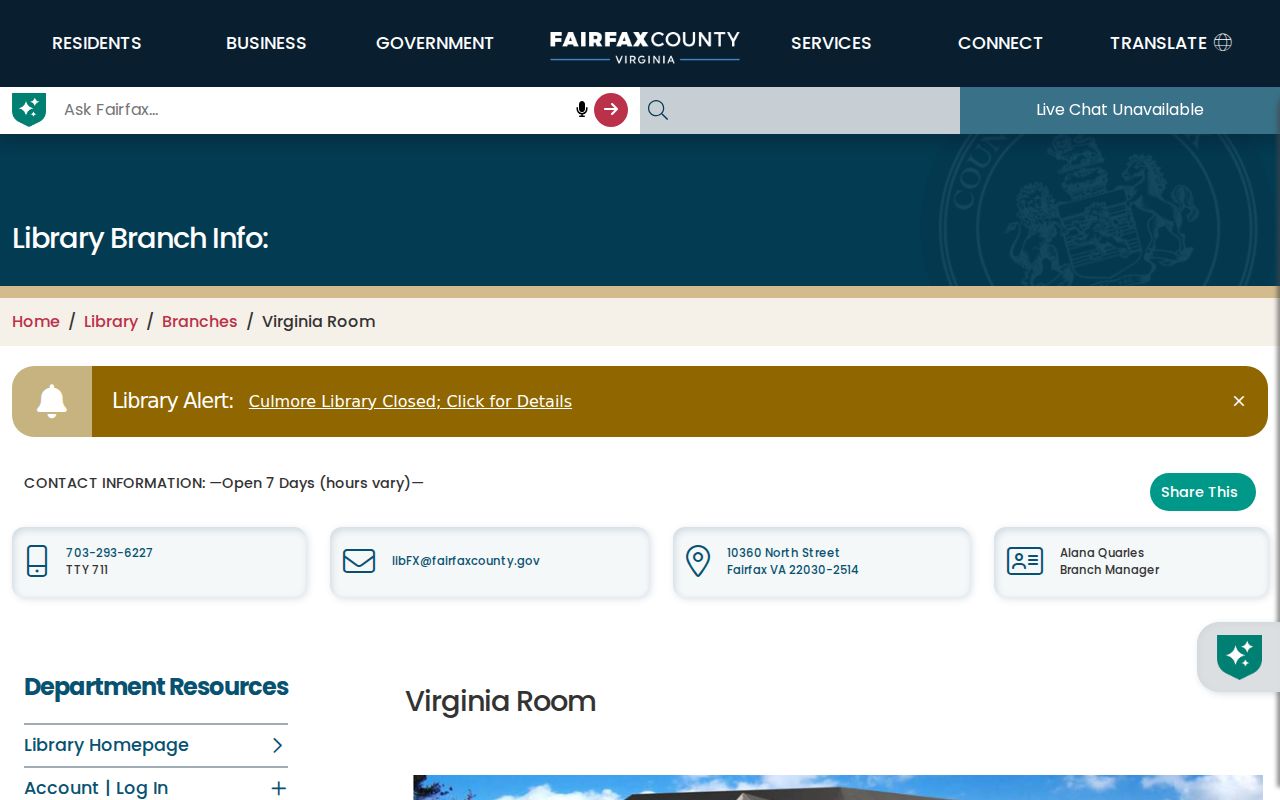
The Virginia Room’s local-history collection is the source shown below. Its directories, maps, newspapers, yearbooks, oral histories, and subject files are useful companions when a city directory gives only a short printed entry.
The collection is most useful when each item is cited on its own terms. A newspaper notice can support a date or organization connection; it does not replace a directory page or establish a person’s current location.
The Fairfax Historical Society finding aid adds another collection-level lead. It covers 1946-2016 and describes correspondence, meetings, membership applications and lists, events, yearbooks, and papers. The finding aid says the items are not online, so arrange a research inquiry rather than claiming the component material can be searched from home.
Tracing Reston City Directories
Follow a household through those volumes one edition at a time. Repeated address and name matches are stronger than a lone line, especially where street labels changed from tract or cluster wording to a modern address. Pair each directory year with the census schedule available for that decade, then use deeds, maps, and newspapers to test whether the same property is involved. The goal is a dated sequence of sources, not a confident story built from one printed name.
- Write down the target address, street spelling, cluster or unit, ZIP label, and the year being investigated.
- Ask the Virginia Room or Reston Regional Library for the exact directory title and whether it has alphabetical or reverse coverage.
- Search the surname and initials, then record the printed address, phone or occupation field if present, page, and edition year.
- Check the same house number in an address-first volume and compare adjacent available years rather than assuming an unlisted year matches.
- Pair the result with a census schedule, Reston Times reference, parcel record, or deed that independently supports the period.
A disappearance can mean a move, a changed listing practice, an unlisted telephone, a regional heading change, or a gap in the volumes held. Keep the absence as an absence. Do not convert it into a death, a move date, or a finding about another family without a separate record.
Reston Directory Names Over Time
Reston’s planned-community history explains why a historical address may carry several identifiers. Robert E. Simon Jr. purchased roughly 6,750 acres in 1961, the Reston Master Plan was adopted in 1962, the first recognized residential occupants arrived in Waterview Cluster in December 1964, and the community was dedicated in 1966. Earlier deeds may describe a tract; later records may name a lot, cluster, village center, map number, GIS ID, or postal address.
- 1961: land acquisition created the tract-level starting point for later Reston development.
- 1962: the Master Plan established planned-community terminology that can appear in local sources.
- 1964: early residential occupancy began, making regional rather than municipal directories especially important.
- 1966: formal dedication followed, while Fairfax County remained the governing records jurisdiction.
The Reston Museum collection has more than 3,000 artifacts from 1965 forward and accepts research appointments. It can add development context, photographs, and organization history. Keep that context separate from a claim that a named person resided at a particular address.